AI Innovation
Decode YouTube Videos With AI Intelligence
Our AI engine transforms YouTube transcripts into actionable knowledge, insights, and searchable text blocks.
By YTVidHub Editorial Team | Last reviewed Dec 2025
Quick Take
- Use summaries to shortlist key ideas before deep watching.
- Keep source transcripts for verification when decisions are high-stakes.
- Export clean text to build repeatable study, content, and analysis workflows.

AI-Powered Study Insights
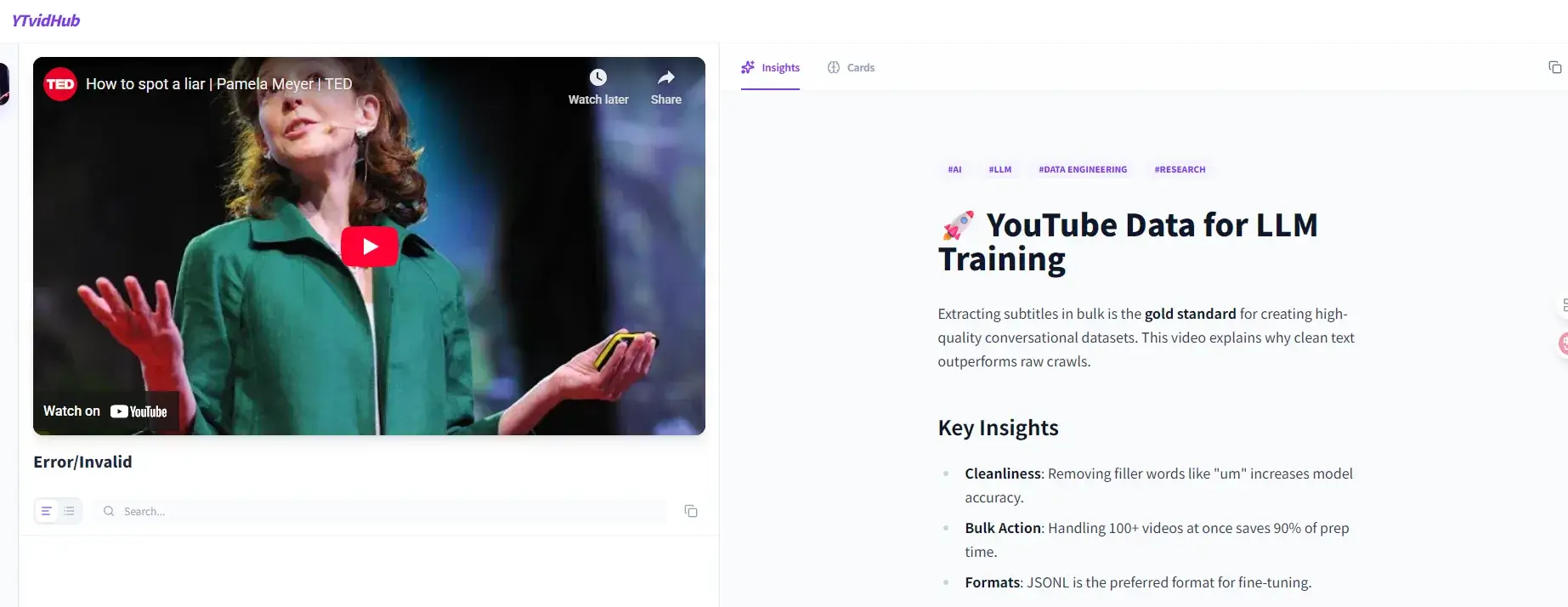
Our AI YouTube summarizer uses advanced reasoning to extract the core value of any video. Stop skimming through hours of footage—get the facts instantly.
Structured Analysis
Automated extraction of key insights and concepts into organized sections.
Deep Insights
Summaries that understand context, tone, and the reason behind the content.
Knowledge Sync
One-click export to Notion, Obsidian, or Markdown.
Language Support
Supports summarizing YouTube videos in 50+ languages.

Smart Transcripts for Professional Research
YTVidHub converts raw YouTube video transcripts to text with semantic grouping, making them suitable for LLM training datasets and deeper content analysis.
Search
Deep-Text Keyword Search
Instantly locate any word across hours of video. One click takes you to the exact timestamp.
Processing
Semantic Time Grouping
Related sentences are grouped into logical paragraphs while preserving speaker flow.
How We Validate Summary Quality
We evaluate summaries against transcript coverage, factual consistency, and actionability for downstream tasks.
- Coverage: key claims and definitions remain present.
- Consistency: summary statements map to transcript evidence.
- Users can inspect transcript evidence before publishing or model training.
Keyword Strategy: AI YouTube Video Summarizer
The core intent behind AI YouTube video summarizer is fast understanding with reliable evidence. Users who search summarize YouTube video usually need one of three outcomes: study notes, content briefs, or research extraction. To satisfy these intents, summaries must stay connected to transcript proof.
We therefore align related keyword variants naturally: AI YouTube summarizer, YouTube transcript summarizer, and YouTube summary tool. Each variant maps to a practical task section so readers can immediately apply the output, not just scan generic feature claims.
To keep output reliable, we explicitly note limitations: if source captions are noisy, summary quality can drop. Transparent quality boundaries help users trust the tool and prevent overconfident conclusions.
Prompt Template for Better Summaries
Summarize this YouTube transcript into: 1) main thesis, 2) five evidence-based insights, 3) action checklist, and 4) unresolved points that need source verification. Keep every claim tied to transcript evidence.
Step-by-Step: Summarize YouTube Video With AI
- 1) Define the goal first. Decide whether the summary is for studying, editorial planning, or research extraction. Goal clarity improves prompt quality and output usefulness.
- 2) Start from clean transcript text. Remove timing artifacts, duplicate lines, and non-speech tags before summarization so the model focuses on meaning instead of formatting noise.
- 3) Ask for structured output. Request sections such as thesis, evidence, key quotes, and action items. Structured summaries are easier to validate and reuse.
- 4) Force evidence linkage. Require each key claim to map back to transcript passages. This is critical for trustworthiness and prevents hallucinated takeaways.
- 5) Run a contradiction pass. Ask the model to list uncertain or weakly supported claims. This catches risky statements before they enter published content.
- 6) Export by downstream use. Keep one concise executive summary, one detailed notes version, and one quote list for rapid content repurposing.
Use-Case Outputs by Team
Marketing
Convert one long video transcript into headline ideas, email angles, and social snippets while preserving source language from the original speaker.
Learning
Build chapter-style notes and revision cards from lectures. Keep transcript references so learners can revisit difficult sections with precise context.
Research
Extract claims, methods, and open questions for literature maps. Store a clean summary plus transcript evidence for auditability.
Common Summary Mistakes and Fixes
- Mistake: trusting one-pass output. Fix: run a second verification prompt focused only on factual consistency.
- Mistake: mixing opinions and facts. Fix: label sections as evidence-backed claim, interpretation, or open question.
- Mistake: losing nuance in short summaries. Fix: keep a detailed version and a concise version side by side.
- Mistake: no quality threshold. Fix: reject summaries that cannot map key claims back to transcript evidence.
Extended Playbook for Teams Using AI Summary Daily
Teams that consistently win with AI summaries treat the workflow as a content operation, not a one-click shortcut. They maintain a stable transcript normalization step, a repeatable summarization prompt pack, and a lightweight review gate before publishing. This creates predictable quality even when source videos vary in pacing, domain complexity, and speaking style.
A useful pattern is to generate three layers of output from the same transcript: a short executive summary for decision makers, a mid-length practical summary for operators, and a detailed evidence map for editors or researchers. The short layer improves speed, the mid layer improves actionability, and the evidence layer protects trust when claims are challenged.
Over time, this layered approach compounds SEO value because each page update can add clarified examples, better evidence mapping, and stronger internal linking to related use-case articles. That helps pages stay useful after initial publication instead of decaying into generic summary content.
Who Benefits Most?
Whether you are building datasets or studying for exams, YTVidHub adapts to your workflow.
AI Researchers
Build clean, noise-free text corpora from YouTube channels for model tuning.
Content Creators
Turn any video into a draft outline with source-grounded key points.
Rapid Learners
Skip filler and focus on structured insights faster.
Frequently Asked Questions
How does the AI YouTube summarizer help with study?
By extracting structured insights and organized notes, YTVidHub automates the analysis process and reduces manual note-taking.
Can I export YouTube transcripts for AI training?
Yes. Clean TXT exports remove common subtitle noise and provide a better starting point for NLP and training workflows.
Does YTVidHub support YouTube playlist summaries?
Combined with bulk workflows, you can process playlist transcripts and generate summary-ready text at scale.
Related Reading
Ready to Master Any Video?
Don't just watch videos. Extract knowledge with YTVidHub AI.
Try AI Summary Free