As the developer of YTVidHub, we are frequently asked: "Do you support languages other than English?"
The answer is a definitive Yes. Our tool accesses all available subtitle files provided by YouTube. This includes Spanish, German, Japanese, and crucial languages like Mandarin Chinese.
However, this answer comes with a major warning: The ability to download is not the same as the ability to use. For researchers, language learners, and data analysts, the quality of the data inside the file creates the single biggest bottleneck in their entire workflow.
Three Data Quality Tiers
Your data analysis success depends entirely on knowing which of these three tiers you are actually downloading.
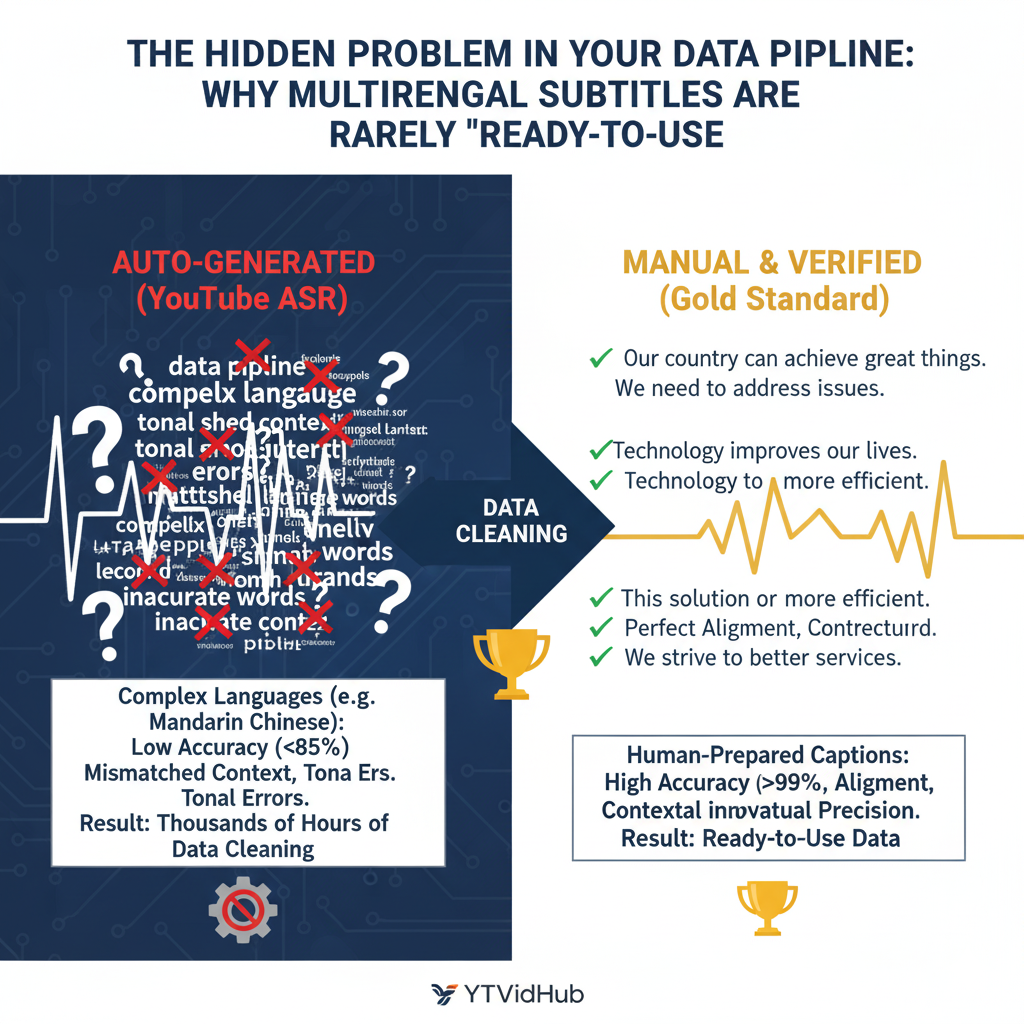
Tier 1: The Reliable Gold Standard
Manually uploaded captions prepared by the creator. These are verified for accuracy and are the best data source for LLM fine-tuning or research.
Tier 2: The Unreliable ASR Source
YouTube's Automatic Speech Recognition. While good for English, it fails dramatically in niche or non-Western languages:
- ⚠️ Complex Tonal Languages
- ⚠️ Accents & High Speed
- ⚠️ 85% Accuracy Cap
- ⚠️ Manual Cleaning Required
Tier 3: The Error Multiplier
Auto-translated captions. These translate already error-prone ASR files, merely multiplying the mistakes. Avoid this tier for all serious applications.
The Real Cost of Cleaning
The time you save by bulk downloading is often lost 10x over in the necessary cleaning and preparation process. We have identified two major pain points:
1. The SRT Formatting Mess
SRT files are for players, not data scientists. They are riddled with:
- • Timecode De debris (00:00:03 -- 00:00:06)
- • Timing-based text fragmentation
- • Non-speech tags like [Music] or (Laughter)
2. Garbage In, Garbage Out
"For academic research or competitive analysis, inaccurate data leads to flawed conclusions. If your Chinese transcript contains misidentified characters due to ASR errors, your sentiment analysis will fail."
Building a Solution
for Usable Data
We solve the problem of access. Now, we are solving the problem of Accuracy and Ready-to-use Formats.
We are working on a Pro service for near human-level transcription.
Join Mailing List for updates