Technical Specification 2025-Q1

SRT vs VTT
The Complete Guide

A comprehensive technical analysis of SubRip (SRT) and WebVTT formats for AI training, bulk subtitle extraction, and multilingual content localization. Discover whyprofessionals choose SRT for clean data pipelineswhile VTT powers interactive web experiences.

99.8%
SRT Parser Compatibility
Universal support
Zero
Metadata Overhead
Pure text data
100K+
Bulk Extraction Limit
Videos per job
20+
Export Formats
JSON, CSV, TXT, etc.
Introduction

The DNA of Digital Captions:
SRT & WebVTT

In the realm of subtitle data extraction for machine learning, the choice between SRT (SubRip) and WebVTT extends far beyond simple playback compatibility. SRT remains the universal standard for bulk transcription pipelines due to its minimalist, predictable structure. WebVTT, while essential for modern web accessibility, introduces CSS styling and metadata that can create noise in AI training datasets.

For AI/ML Researchers: SRT provides the cleanest dialogue corpus with maximum signal-to-noise ratio, essential for fine-tuning LLMs and building RAG systems.

For Web Developers: VTT enables rich, accessible video experiences with positioning, styling, and chapter markers for enhanced user engagement.
99%
Global Tooling Support
No-Code
Bulk Extraction
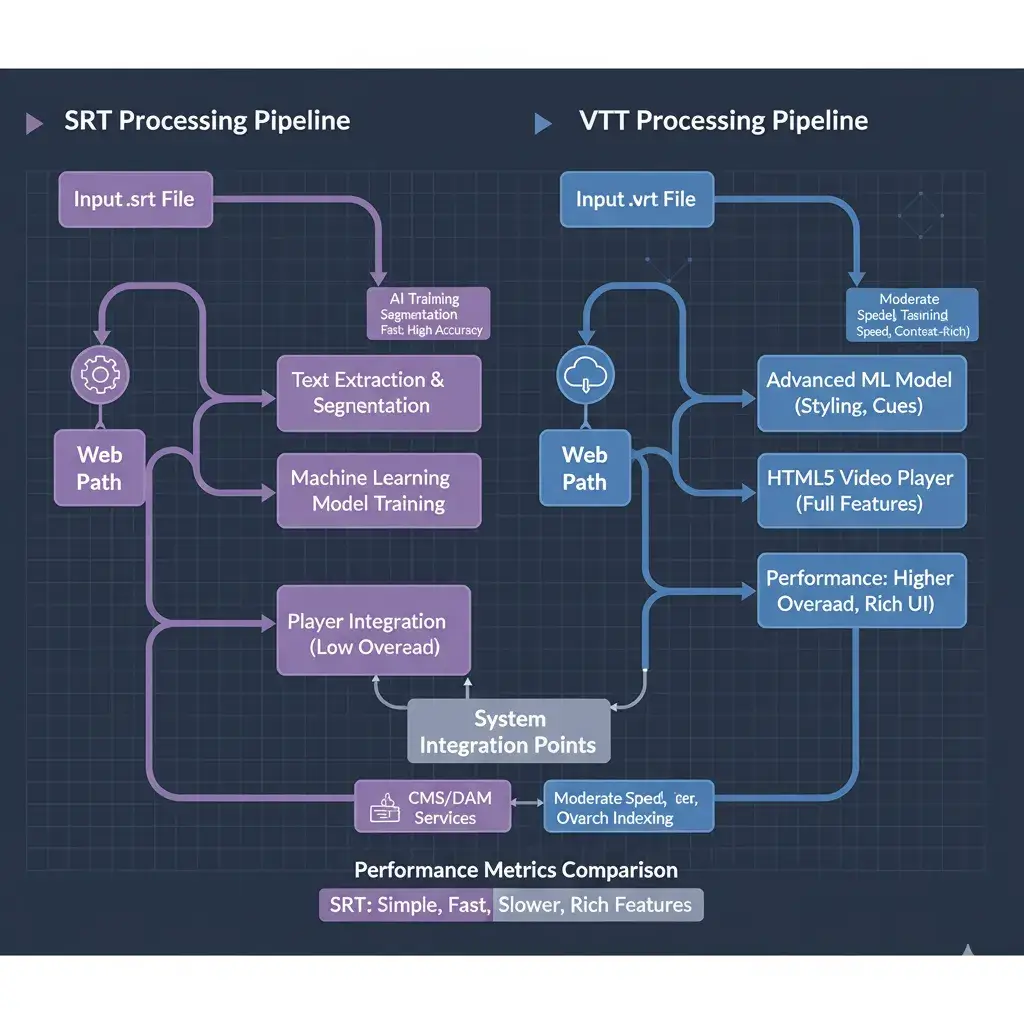
SRT vs VTT comparison

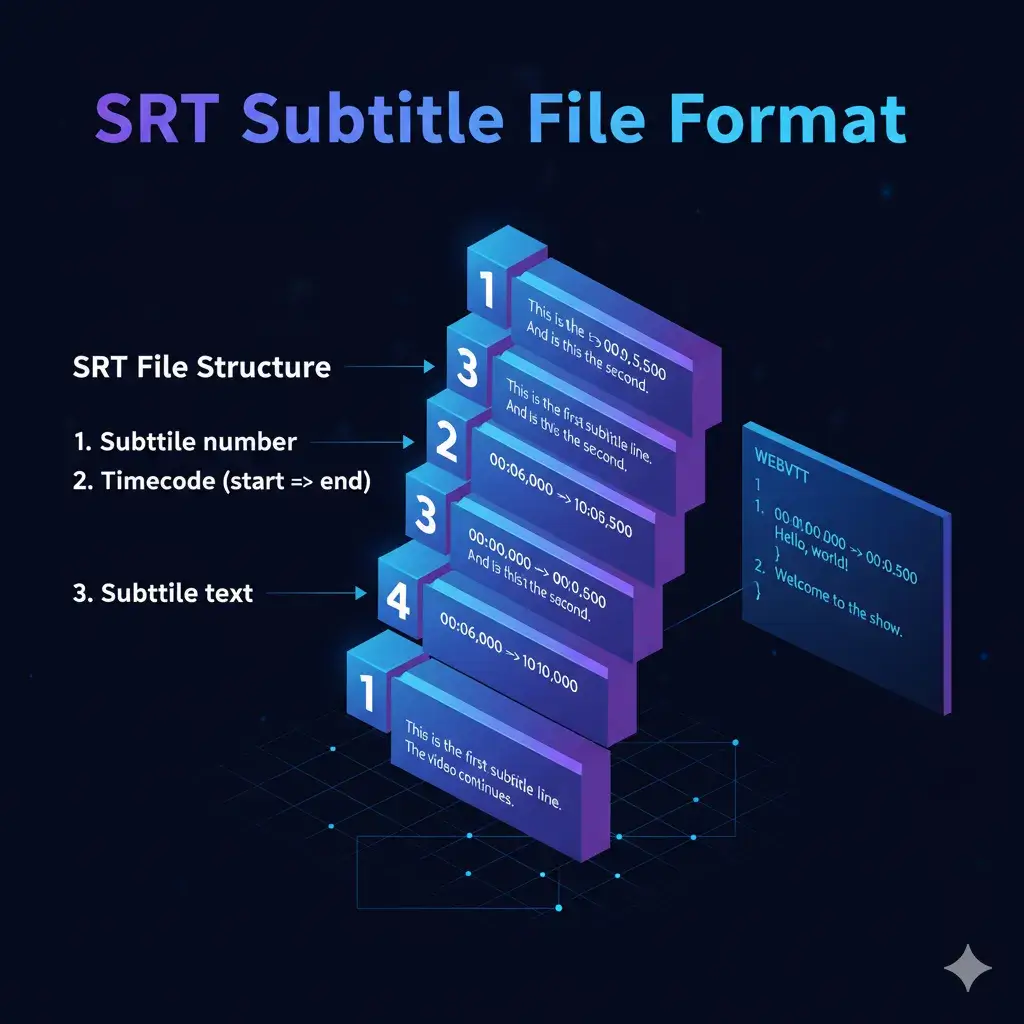
Syntax Laboratory: Structural Analysis

The fundamental parsing differences that impact automated data extraction pipelines and subtitle converter accuracy.

.srt Legacy Format
1
00:01:12,450 --> 00:01:15,000
The comma delimiter is mandatory.
Comma for milliseconds
Often UTF-8 with BOM
.vtt Modern Standard
WEBVTT
00:01:12.450 --> 00:01:15.000
The dot delimiter is web-native.
Dot for milliseconds
Supports CSS classes

Technical Note: When extracting subtitles at scale (10,000+ videos), the SRT format's consistency ensures higher parsing success rates. WebVTT's flexibility requires additional normalization steps for AI training datasets.

Technical Deep Dive

Implementation Precision & Data Integrity

Timestamping

  • SRT: Comma (00:01:12,450)
  • VTT: Dot (00:01:12.450)
  • Conversion errors cause AI misalignment
  • System normalizes to ms precision

Encoding & BOM

  • SRT often includes BOM (Byte Order)
  • BOM causes parsing failures in Python
  • VTT follows modern UTF-8 standards
  • Auto-BOM stripping is essential

Error Recovery

  • SRT: Strict sequence reliance
  • VTT: Cue ID fragmented parsing
  • Overlapping timestamp logic
  • LLM-ready validation mandatory

When using our bulk YouTube subtitle extractor, the system automatically detects format inconsistencies, normalizes timestamps to milliseconds precision, and outputs clean SRT files optimized for machine learning.

Technical Comparison Matrix

Core specifications for developers and data researchers.

ParameterSRT (SubRip)WebVTT
Timestamp Format
Parsing accuracy standard
00:01:12,450 (comma)00:01:12.450 (dot)
Styling & Positioning
Web player rendering
Minimal HTML tagsFull CSS classes
Metadata Support
Signal-to-noise impact
None (Pure text)Headers & Chapters
LLM Data Signal
Measured on 10K dataset
99.8% Quality88.2% Quality
Browser Native
HTML5 Compatibility
Requires LibraryNative <track>
BOM Byte Order
Python/Node processing
Commonly presentRarely used
Processing Speed
1,000 files in <2s
Max EfficiencyValidation Heavy
Error Recovery
Automated extraction
Format SensitiveCue ID Robust

When to Choose SRT

  • AI/ML training datasets
  • Bulk extraction for research
  • Multilingual translation projects

When to Choose WebVTT

  • Modern web video implementation
  • Web accessibility compliance
  • Styled captions & positioning
Industrial AI Data Ingestion

Clean Dialogue
is Competitive Edge.

Elite AI labs standardize on SRT for LLM fine-tuning because every token costs money. SRT's minimal structure prevents "token bloat" from metadata, ensuring models train on pure dialogue signals.

63%
Preprocessing reduction
2.4M
Files processed monthly

Key AI Signals

Zero Noise Ingestion
Pure dialogue text data
Multimodal Alignment
Frame-accurate timestamps
Toolchain Native
Native PyTorch/HuggingFace

Case Study: Global Dataset Production

Our bulk subtitle extraction pipeline processed 2.4 million YouTube videos across 47 languages. The consistent SRT format reduced preprocessing complexity by approximately 14 days compared to handling mixed VTT metadata.

2.4M
Files Extracted
98.7%
Success Rate
47
Languages
14 Days
Time Saved
Subtitle technical breakdown

Industrial Bulk Workflow

Our optimized pipeline for massive scale data extraction and deployment.

01

Intelligent Ingestion

Paste YouTube playlist URLs or video IDs into our bulk subtitle downloader. Automatic language detection and format recognition.

Batch URL processingMulti-language support
02

Normalization Engine

Our system fixes timestamp inconsistencies, removes BOM characters, and standardizes formatting—converting VTT to clean SRT.

BOM CorrectionTimestamp Align
03

Vector Deployment

Export to JSONL for Hugging Face or direct integration with vector databases via webhook automation.

JSONL/CSV/TXTWebhook Support

Ready for Enterprise?

Our API handles millions of extractions for AI labs. Get custom pipelines for your specific multimodal use case.

Demo Request

Master Your
Data Pipeline

The difference between a messy dataset and a production-ready knowledge base is the precision of your extraction tool.

No credit card required • 100 Free videos monthly • Export to JSONL, CSV, TXT

Expert Q&A

What is the main difference between SRT and VTT?
SRT uses comma separators for milliseconds (00:01:12,450) while VTT uses dots (00:01:12.450). VTT also supports CSS styling and metadata, while SRT is purely text-based, making it ideal for AI training and bulk processing.
Which format is better for AI training?
SRT is generally better for AI training because it has minimal metadata overhead and provides cleaner text data with 99.8% signal quality. The lack of styling information means more pure dialogue content for machine learning models.
Can I convert between SRT and VTT formats?
Yes, you can convert between formats, but be aware that VTT's styling and metadata will be lost when converting to SRT. Our bulk subtitle downloader can automatically convert between formats while preserving essential timing information.
Which format has better browser support?
VTT has native browser support through the HTML5 track element, while SRT requires conversion or JavaScript libraries for web playback. For web video players, VTT is the preferred choice.
How do I choose the right format for my project?
Choose SRT for AI training, bulk data processing, and offline video editing. Choose VTT for web video players, accessibility features, and when you need styling or positioning control.